
Funny simulation games: non-human times and mischievous dogs
Ian Cheng, tyranny of cybernetic simulation, uncertainty as the path for the future

Written during a residency with Projekt Atol and ŠUM magazine in summer 2023. I am indebted to Tjaša Pogačar for inviting me and letting me stay in the beautiful Ljubljana apartment.
Industrial capitalist modernity disenchanting our sense of embeddedness in everything and scientific method gave us very different ways of world-relating. Add a bit of cybernetic imagination that begins with Norbert Wiener and military-industrial complex and you get what game theorist Patrick Crogan calls gameplay mode. A technosphere plugged into war and simulation machines, on the backdrop of accelerating politics where pushing a button and sending an intercontinental ballistic missile with nuclear payload has minimal latency.
Mass computation accelerating preemptive view of post-1945 politics propagated through pop culture. SimCities, Sims, strategy games, FarmVilles, precision agriculture algorithms, drone images, surveillance maps, LIDARs, journalistic graphs of record-breaking temperatures, urban plans, flowcharts, slices in the continuous flows of energy and potentials that leave us in the elevated position.
Norbert Wiener dreamt of an anti-aircraft system that would be able to record the controller's shooting style and adjust for any statistically significant deviations. Merging of a war-body and technology extrapolating from the past data. A top-down dream where you have the preemptive and predictive power. Algorithms feed data from a massively distributed intelligence network in order to act even before the act begins. Magic of perfect battlefield control.
It’s also a logic of modeling, of simulation, of top-down diagrammatic map that encloses the territory and throws a shade in it. “The simulation is for Crogan good at getting you to not ask for more,” says Cameron Kunzelman and Michael Lutz in their podcast dissecting the book – the “more” here symbolizes the enveloping power of simulation. A small model of the world that acts like a representation but actually is a system that “tells you what kind of representations are proper or valid”, one that sets “boundaries of what it is going to represent and then asks you to judge them only within those boundaries.”
Simulation not only shows, but interprets the world as an actable space, one which rules can be governed, mapped onto a certain technological matrix with its more or less hidden affordances. Opaque user interfaces like the ones from 2000s sci-fi movies. A planet appearing moldable, distanced. This does not mean only top-down plans: what Keller Easterling calls the operating system of a city and emergent urban properties are very compatible with cybernetic gaze.
Ian Bogost in his review of Gameplay mode proposes a definition of the eponymous concept as “the tendency to blend reality and simulation in the hopes of better controlling reality.” It is a map that overtakes the territory – not only you would have a great overview of the terrain with all the important data nodes and their courses of action, but the simulation here acts as a kind of hyperstition. The mere presence of a prediction machine creates a feedback loop that in return molds reality according to its logic. To a god-view of the control center everything looks like a pawn.
“You and the map are the same.” It’s a farm game where the farmsteading is simulated with extreme accuracy, as if every animal you had wore a GPS module. In many ways, its no surprise we got precision agriculture.
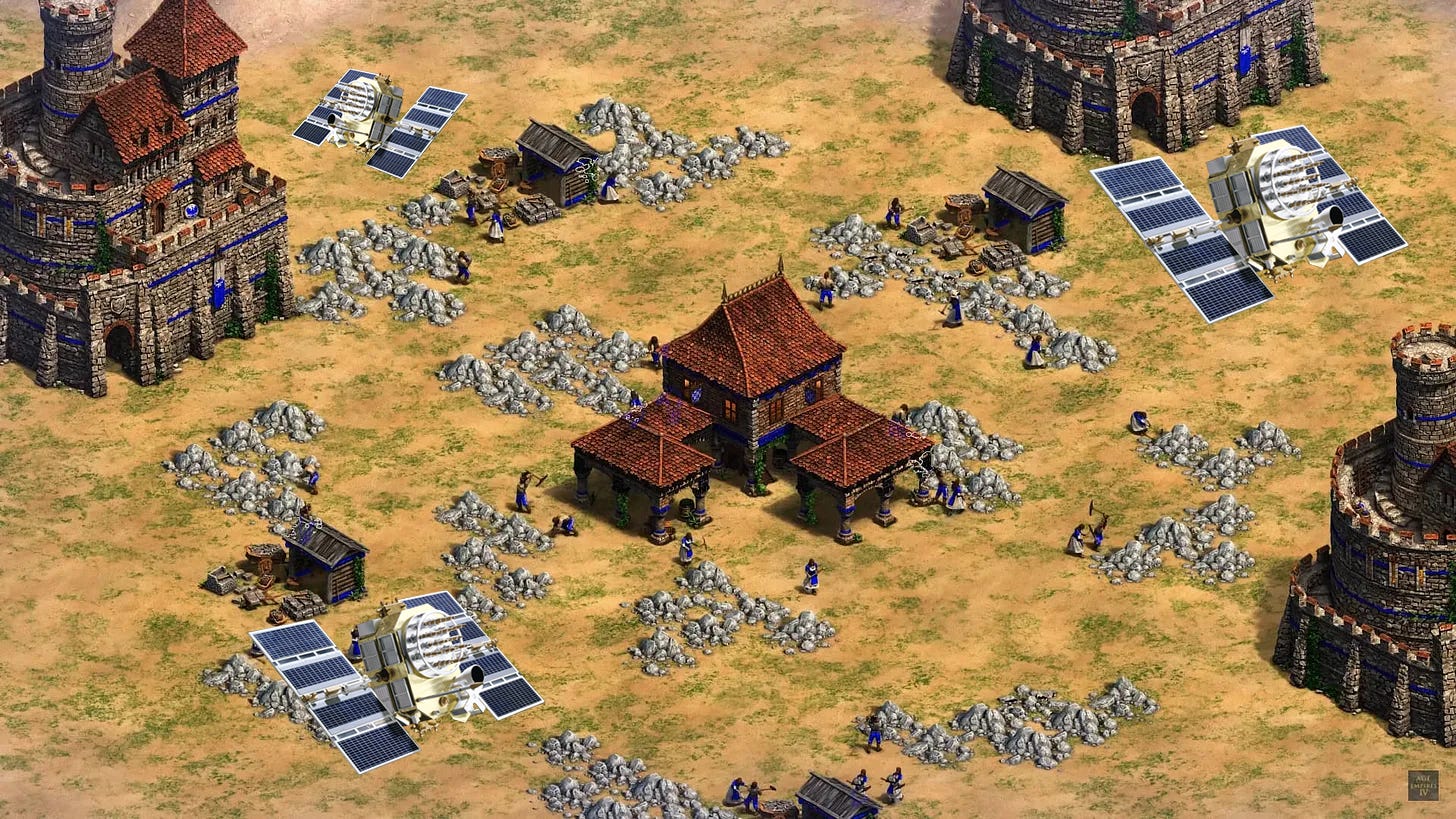
Another example you might be familiar with: Age of Empires, perhaps II. The undisputed king of the medieval real time strategy games represent the middle-ages warfare as a perfect interlocking system of rock-paper-scissors mutually countering units: horses, archers, pikemen, infantry, siege. Not only is every unit theoretically perfectly directable (the best players achieve more than 160 APM, in-game actions per minute), but there is a perfect logic underlying their production and economic value. Since every single unit of a given type is the same and has the same cost, they operate as a perfect economic units on the macro-scale that in AoE involves gathering resources, expanding bases: balancing inputs (gathered/traded resources) and outputs (the units quite literally spent to gain advantage). Experienced viewers might predict how a given march can go by looking at the infrastructure of opposing players.
There is randomness in the semi-auto generated terrain, but only some as the algorithm for creating maps takes into account economics of the game, too. The rest can be broken down to numbers, charts, gold-mined-over-time, scores and every other bit of information. Gradually, you can paint a statistical picture of the most successful strategies on a given map with consideration for the different civilizations involved. A perfect overlook. And we should not undermine the affective/phenomenal role that the “seeing like a state” situation plays here. Top-down, disembodied, god’s view only circumcised by the “fog of war” (a concept devised by the Prussian army for their analog simulation Kreigsspiel, propagated through centuries) of unknown terrain. A click of a mouse representing mighty, frictionless intervention.
A scientific, computer layer that propagates up to the screen of your phone where you track if there’s gonna be rain in Ljubljana today. We feel like we see the world, but under nicely animated clouds is a whole infrastructure that sends you cookies flying in order to improve user experience, through the data centers of meteorologic companies who take readouts somewhere and who even knows where. It’s networked logistics of information embedded in a little icon in our hand.
There are a couple of problems that the idea of governable reality presents. For one, there is always a necessary reduction in translating continuous phenomena into binary data. Data is already political, as much as the measuring devices used to create data points. On a very epistemological level, the simulated map can never fully encompass the territory, yet this virtuality (in a sense of non-corresponding with the physical reality) enables effects that shape matter in return nevertheless.
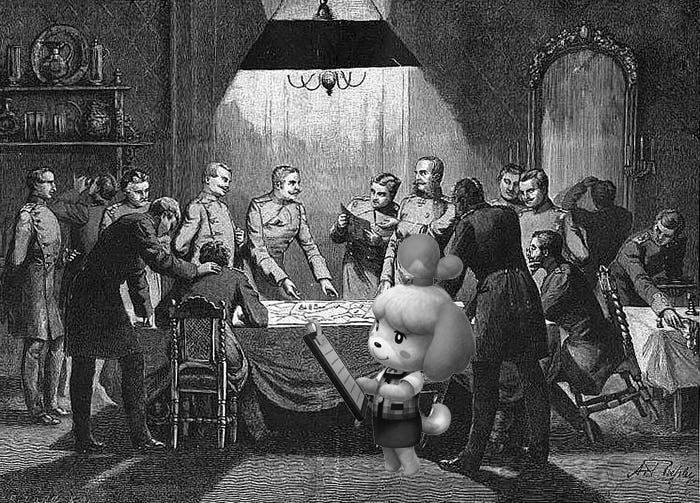
Crogan describes the advent of preemptive war-simulation computation as “war on contingency”, accelerated through war on terror (Amy Ireland in Black Market exhibition catalogue calls it “furious battle with the future”, “war on time”). Tiqqun wrote in the The Cybernetic Hypothesis: “To govern would become a rational coordination of the flows of information and decisions that circulate through the social body,” citing Karl Deutsch and his positive vision for cybernetic power. They call it “the most consequential anti-humanism”, “unlimited rationalization” anatomo-politics”. Worldview which we are encountering everyday even in innocuous games like Animal Crossing or (maybe especially) Stardew Valley that imagines the whole planet as a network of malleable nodes.
A way out is, perhaps, through
Kunzelman and Lutz take an issue with Crogan and cyber-sceptic, technodeterminist worldview: if the whole system is neatly built as totalizing (they talk about borromean know of mutually reinforcing and supporting triad of technology, simulation and war), where, then, is a margin for resistance? They find it in the fact that structure is one thing, but the libidinal, emotional engagement is another. There are many ways one can enjoy videogame. Yes, there are preferred readings, paths we are nudged towards, but there is always a space for action.
To paraphrase Alexander R. Galloway: what would a counter-simulation look like? Especially in relation to the horizon of climate crisis and planetary future, where there is an amount of progressive videogame works to choose from – simulations of dynamic planetary processes involved in climate crisis (Beecarbonize, disclaimer: I did marketing for this one), imaginations of global socialist government players can take a seat in and direct a green future (Half Earth Socialism) or more narrowly focused emancipatory models of US energy transformation (Green Deal Simulator).
Artist and Researcher Filip Hauer in his unreleased paper criticizes these approaches as assuming weird politics of unlimited, albeit progressive, totalitarian-adjacent government. I might add that they, too, perpetuate the flattening logic of gameplay mode as they imagine implementation of green policies, technological upgrades, infrastructure alterations or various aspects of human society through a very flattening rationalist/cybernetic lens: a perfectly calculable effects with predictable outcomes, streamlined as currency in the in-game economies.
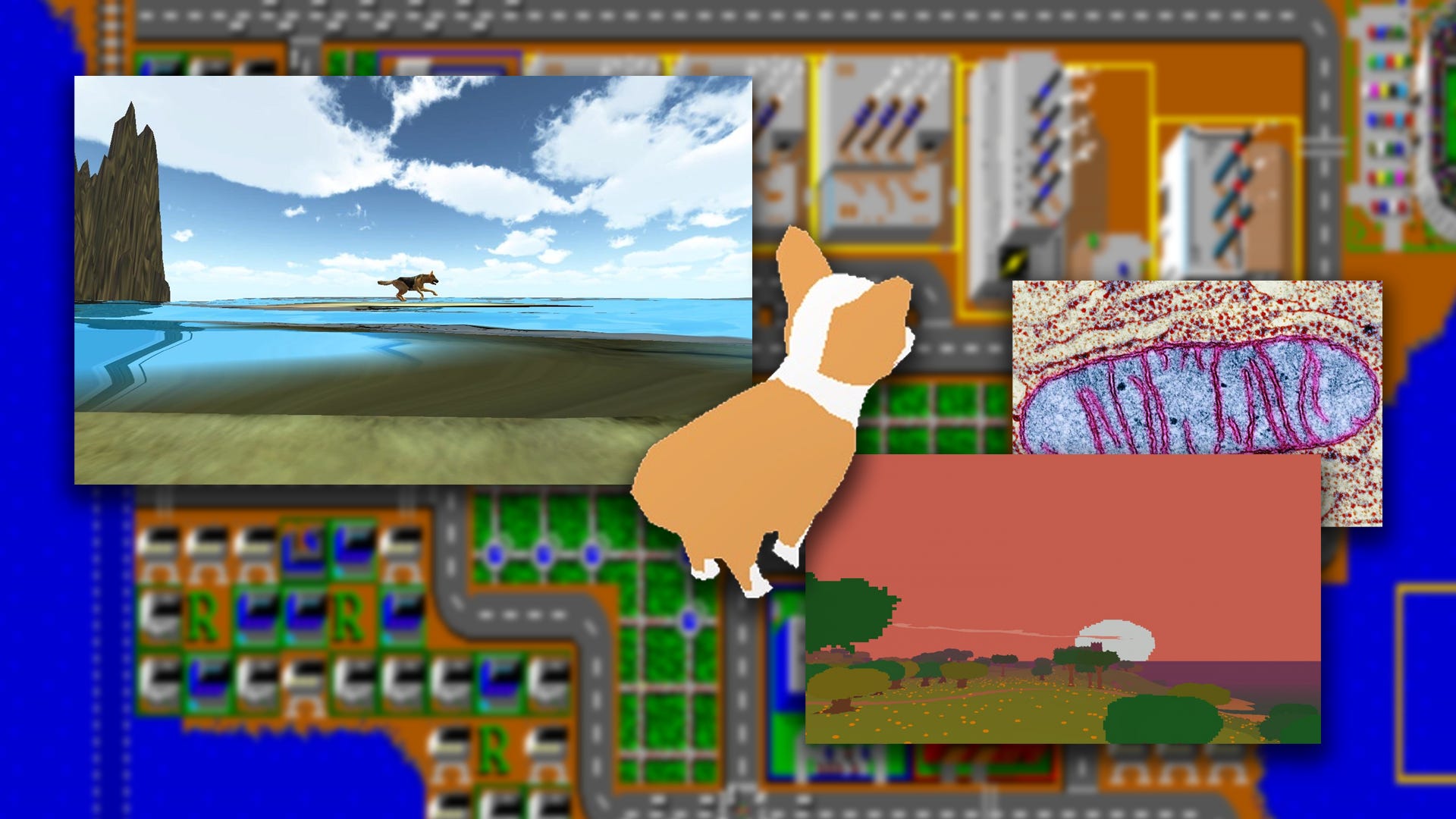
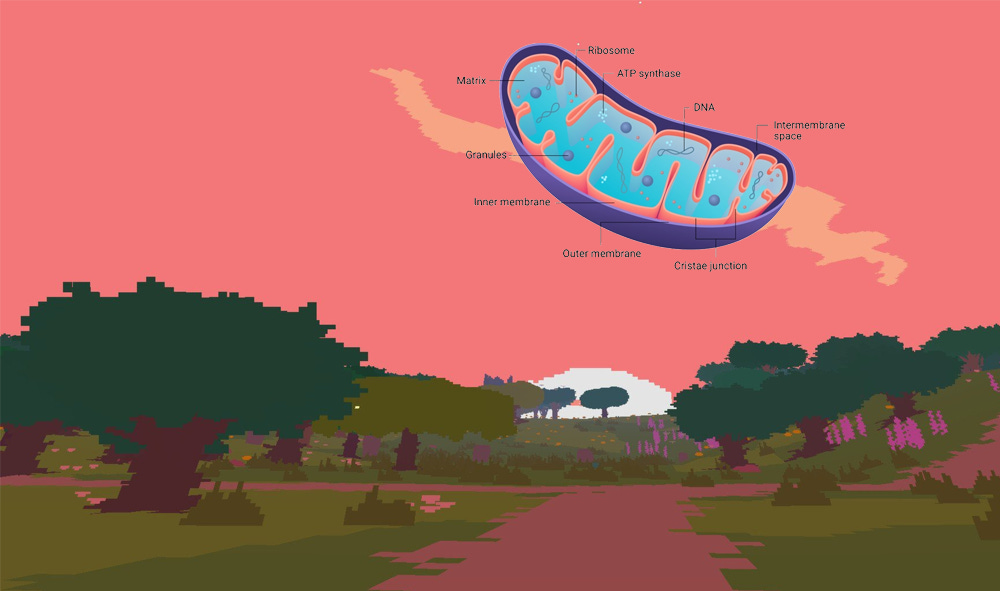
If we are looking for a way how to break this cycle, philosopher Timothy Morton has an interesting proposition in their book Being Ecological. Its argument (crudely simplified) is that we don’t need more of well–meaning datafied information about global warming to persuade people, but works of art that can help us realize the ecological-nature of our very being, the unsustainable divide between “humans” and “nature”. Which is exactly where your mitochondria and its internal DNA different from yours (!) or recent resurgence of interest in microbiome comes into picture.
From that perspective, realizing our inescapable alienation from ourselves (and modern myths of nature/culture divide) sounds a lot like a problem of creativity. Amy Ireland describes creativity as that which goes against “habit”, “hallmark of which is predictability.” A direct opposition to gameplay mode, in the case of her text it is the unmappable alien “zone” (in Annihilation, Stalker and elsewhere) that unsettles the mapping efforts of Crogan’s simulation machine. Perhaps we bear zones like these within us, only rediscovering them quite ironically thanks to the most modern scientific techniques (DNA sequencing): “Every habit has its zone” that produces something “radically new.”
A counter-gameplay game, one with potency to break habit would have to:
refrain from totalizing, information-rich simulation with a “non-future orientation” (Crogan)
push against notions of “mastery” that is propagated through the whole medium of videogames, one that directly stems from war-technosphere simulation logic
(in our planetary case) should allow us encounter the entangled reality of our bodies, human as always embedded and co-created with its environment
(in our planetary case) should represent human being as happening on a very particular time scale, one that is different, but nevertheless tied to the rhythms of the planetary processes, trajectories of solar system futures (sun death) or even universal ones (heat death, entropy)
takes contingency as its main structural paradigm
As of now, no such game exist. But perhaps we can take a more distributed approach, one, in the end, more suitable to the way logic of simulation gets disseminated, embedded and resurfaces in a myriad ways, too. A space of counter-gaming possibility. With that in mind, there are notable titles, games and approaches.
No man is a virtual island
This critical inquiry nevertheless treads a thin line between using the language of games as a subversive practice and the danger of falling back into the simulation trap. It is an open question, then, if there even is a potential to create a counter-game (or xenogame) within the confines of the simulator genre as such. I tried to inquire into this question before in the case of Lichenia, a great case study in one approach to critical design, which I nevertheless feels leaves a lot to be desired when viewed through the critical lens of gameplay mode.
Lichenia is a “reverse city builder”, a game that tasks you with rejuvenating a post-ecocatastrophic land utilizing a set of interventions. They take on a form of different blocks, their impact on the game grid opaque as there is no manual, no description – we might also go as far as interpret them not as materials to be placed in one singular place of the grid (as is often the case in city building games like building a road piece by piece, square by square), but as infrastructural interventions. The game also presents players with a bar showing balance of different parts of the ecosystems. There is no end, only perpetual co-existence with the space, terrain and their rules.
In 2020, I interpreted this game situation through Keller Easterling and her medium design and Ian Bogost procedural rhetorics, to highlight how the system in Lichenia is not a masterplan (as in SimCity), but an emergent situation with hard to discern rules, perhaps similar to what Vít Bohal calls for in the aforementioned Xenogaming essay.
Today I am not so sure. If the logic of preemptive war-simulation-technology is precisely in trying to map the contingent phenomena with the aim to master them and act upon them, is Lichenia anything else that just an exercise of that? With disembodied player overlooking the terrain and even though it rules might not be neatly laid down, Lichenia still represents a space where simulation is there to be manipulated with a goal in mind (even though the game technically has none): increasing the amount of green areas and keeping the whole system in check, including sometimes occurring catastrophes like wildfires. In a way, Lichenia, then, is a much more truthful representation of the current simulation space: one that has to take the possible interference into account, one that operates in a space that includes unknown variables (“unknown unknown” as Amy Ireland quotes american minister of defense). But the simulation still nudges its user to control it and take over the map.
One good example of a game with affective and at the same time counter-mastery potentials might be a small Proteus by Ed Key and David Kanaga. As a so-called “walking simulator”, Proteus does not offer any of the traditional components of a first-person 3D videogame. No goals, no score, no action. Only your presence on a procedurally generated island, a few keys for looking around. And a pleasantly eerie sense that something is “off”. Ian Bogost describes multiple layers of productive player alienation. At first, “in Proteus you are not the you you are used to.” Floating on water without any boat. In comparison to other first-person games, “something’s off this time, something subtle. Different terrains can be traversed without distinction.”
Even the surprise one might feel from delving into Proteus with more classic game expectations in mind aside, Bogost offers an enticing analysis: “There is no “you” in Proteus, (...) The experience you have on that island isn’t an experience on an island, at all. Instead, it’s an experience of an island. (...) Proteus is a game about being an island instead of a game about being on one.”
This decentering of the player's agency is but a one of possible antidotes to controlling simulation actor position we are used to be. In conjunction with the first part of my article, Proteus nevertheless can be read through the lens of nonhuman/post-human sensibility. There is a time on the land, but it does not visibly pass (unless you stand in one, specifically designated place, in the stone statue circle, as in some kind of ritual) in the same way human time would: “Day and night doesn’t pass, so much as the island dresses in day and night’s clothing. Night doesn’t descend upon the island so much as the island nights (...).” For the most part, Island is disinterested in you, apart from a swarm of hens on the ground and there is not much more involved than a sound effect of their feet when they scutter away from you.
For Bogost, “In Proteus we find something in between the personal time of human agency and the historical time of tectonic effects.” The multimedia object that Proteus as a game is speaks about that on multiple levels – from the stylized, but deeply enchanting visual style (similar to pixelart, but not quite), across limited interaction that leaves us in a weird limbo of not-human-enough agential position, to the presence that is disembodied, but far from the god’s eye of strategy games: more like a wandering formless spirit that is there with the island, coexisting.
Contemporary queer game theory lens could view Proteus as a “nofun” game, upending the values of domination and competition and it would be right. But reducing the emotional terrain of the game to a subversive anti-capitalist potential would mean to be at loss in the deep-entanglement it provides. Deep time, sympoesis, post-anthropocentric perspective is all present here. It is still a simulation, yes, but one where contingency (even though present in the autogeneration of the terrain) does not play a role. What we’re left with is dwelling in an unknown land that is the very one we currently stand on.
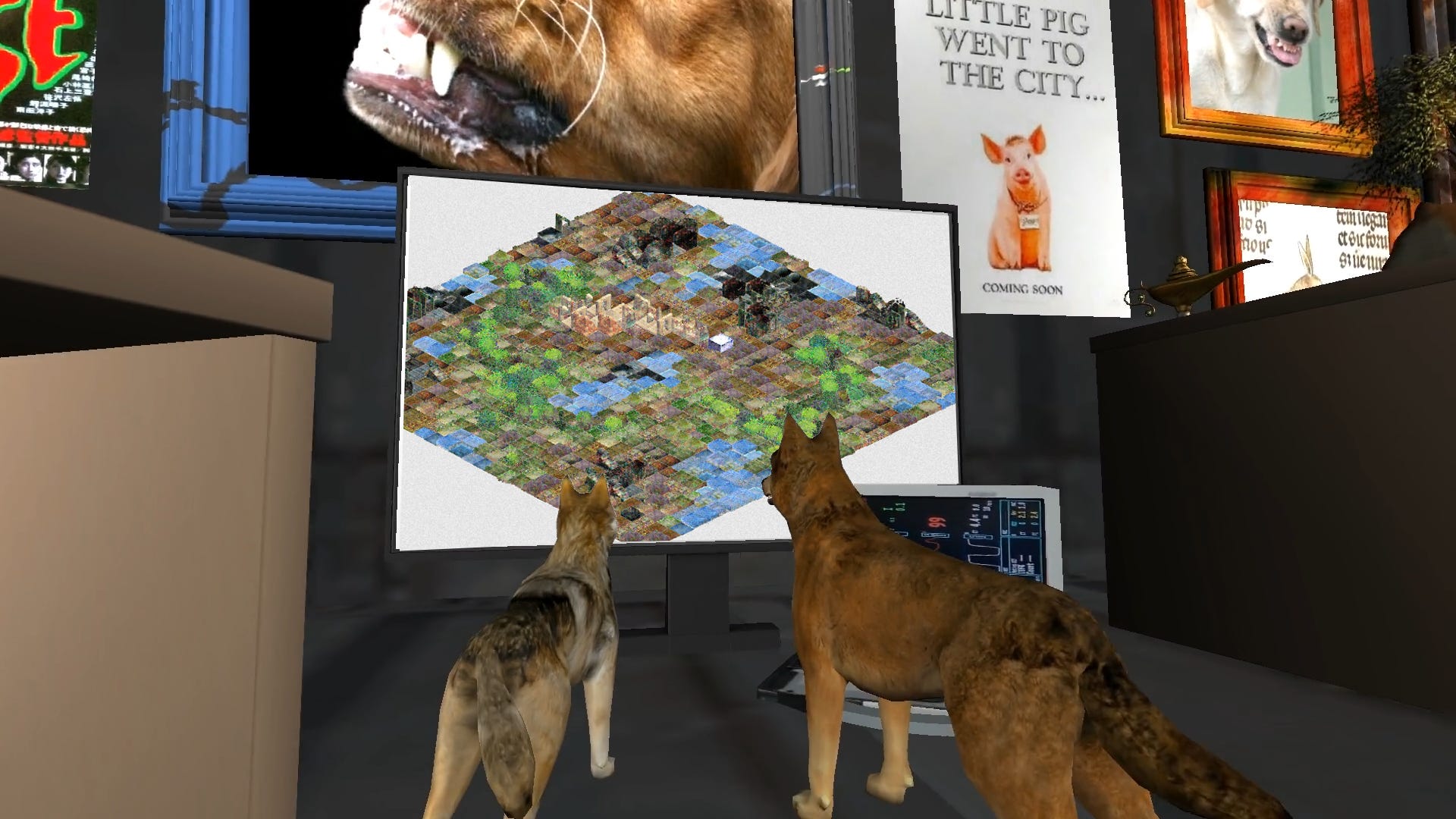
There are some other games that viewed through this simulation-critical lens afford potentially transformative experiences. Oikospiel by David Kanaga (co-author of Proteus) is in-part an exploration of the simulation substrate that is used by developers all around the world to create their works. Kanaga constructed this “dog opera” utilizing parts bough at the asset store of Unity Engine, not only audiovisual elements (3D models and like), but also algorithms like camera navigation systems, movement packages and more. The result is not only an appropriation-core in terms of its aesthetics, but deep interrogation of the labor histories and substrate that makes contemporary simulation/videogame creation possible in the first place. Rough-edges, disorientation, blurring of authorship are the main pieces of the self-reflective circle which player enters as a part of videogame-libreto – there is a beginning and there is an end, but the critical potential is at the heart of the creation process itself.
Herding futures
However, as a conclusion of this section, I want to discuss a work of Ian Cheng. As a contemporary artist, Cheng frames his practice as “videogames that play themselves” and is most known for creating movies based on intricate open-ended simulations, developed within videogame engines. Due to their limited accessibility in a gallery context, I will focus on one of Cheng’s works: Bad Corgi (2015), a “mindfulness app” commissioned by Serpentine Galleries.
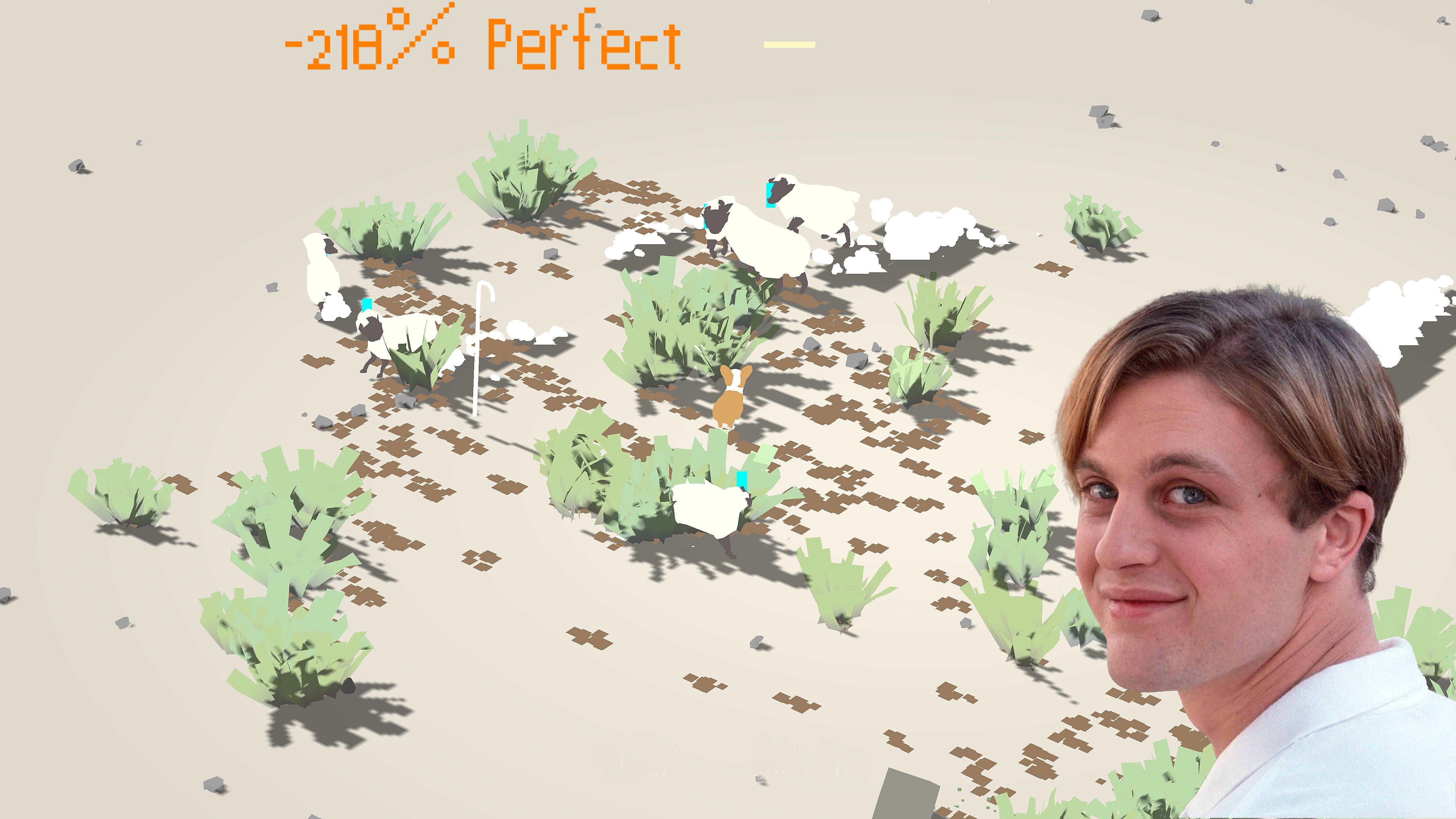
In a game, the player controls a corgi (a dog breed reappearing in many Cheng’s works, he also owns one) herding a sheep pack. The corgi is erratic, both towards the disembodied herding pole that is pestering him and curbing his hard-to-predict movements. Player can point a corgi in some direction, but the result is never a smooth gameplay experience – there are always clashes (with the environment, other agents), on-screen text bursting with comical messages (“Corgi displaced shrub - so bad!”), unexpected new encounters, sudden changes to environment. Even though the game/app/artwork offers a semblance of traditional mechanics in the form of “perfect %”, it is never possible to win and play it in the ideal way – which, in game lingo called “minmaxing” is something simulations tend to provoke players to do. In Bad Corgi “you have no chance in hell of doing a good job.”
Sheep scatter and seemingly randomly run around, the whole screen turns grey in a borderline area from which a big black ball rolls to destroy any semblance of order. Shrubs disintegrate, corgi thwarts your attempts to direct him. And, perhaps surprisingly, it is a relaxing watch – a situation on the surface belonging to the area of simulator games, but estranged from this tradition, with no adherence to instrumental values it usually represents.
Cheng himself situates his work in relation to contingency, often evoked by cybernetic discourse: “I see my simulations as a kind of neurological gym (...) means to deliberately exercise the feelings of confusion, anxiety, and cognitive dissonance that can accompany life in a world of intense change and uncertainty.” Specifically, Bad Corgi is, according to the artist's intent “a shadowy mindfulness tool about refusing to eradicate stress and anxiety, and instead learning to deliberately setup and collaborate with those bad-feeling feelings.” Even though he calls works like Bad Corgi simulations, they are in a sense counter-simulations, foreclosing any idea of smooth space with clearly readable data. Exertion of control does not work the way you’d guess. Sometimes, there is no control at all.
It is Cheng’s appropriation of the videogame language that is especially potent. Considering Bad Corgi is in the App Store, freely available to anyone, in the “Fitness and health section” is kind of an inside-job, a discursive trojan-horse pointing in the counter-gaming direction. Not confined to already elitist space of gallery, but circulating in the hubs where Crogan’s simulation is the rule of the land. Cheng himself says he’s trying to “cannibalize” videogame form, “take from it all the qualities that are so effective - the ability to focus your attention, to be ‘portaled’ into another set of another set of laws, and to discover, inhabit and play those laws as a brief suspension from normal habits and routines.”
The suspension of “normal habits and routines” points in the direction discussed by Amy Ireland above. And since for Crogan “to speculate on the future is to make the means of speculation possible,“ that is in order to think about the future you already have to create a model of what future can be, the habitual disruption that Cheng’s oeuvre offers has a distinct political content. It unearths the construction of seemingly innocuous predictive and preemptive cybernetic systems and simulations we are immersed in all the time. Bad Corgi is bad not only in terms of not being able to handle herding properly, but bad in a sense of causing mischief in the metaphorical cogs of the cybernetic machine. Using its own weapons against it. Instead of Weiner’s perfect merging of man and machine, Cheng’s works like Bad Corgi shows the seams and makes us acutely aware of them – in aesthetically seductive and cute form as well.
Death, sure, but how?
Gameplay mode is, then, a powerful possibility space: both for the dominant structures exerting their power over us and our view of the future as well as a margin of critical possibility, either stripping the simulation logic to de-center the human and agential conventions (Proteus), material inquiries (Oikospiel) or by appropriating its devices in order to show where the machinery creaks (Bad Corgi).
These are but a few examples that show possible approaches, but it is not by far the exhaustive list. Let’s then fall back onto the original affective and ontological landscape where human bodies are always entangled with nonhuman ones as well as heritages of intraspecies relations embedded in our tissues (Mitochondrias in our cells); simultaneously, the celestial rhythms and energy transformations form a probable “eschatological” horizon of our lifeworld. These are all ideas that can be subject to critical simulation inquiry – also due to the fact that it is precisely the simulation space where our encounter with them happens the most. Scientific imagery, evolution simulations, weather/climate predictions in interactive diagrams, also biological discourse feeding back itself into cybernetics (evolutionary algorithms).
Lukáš Likavčan interrogates a question of limits in relation to ecological thought: “we are biased against those [constraints] that make us actually well aware of our position as agents in the metabolic multitude.” He concludes that “It is crucial that politics is thus not about deliberating in some special zone of human affairs, but about distributing human autonomy in the field of planetary entanglements.” This to me sounds very much like a rejection of the cybernetic overview effect where the human agent’s position is always privileged, interface and flesh becoming the hand that governs the reality and/thus the future. Metabolic multitude and field of planetary entanglements stand in direct opposition of this totalizing logic of simulation.
But as Proteus, to some extent Oikospiel and with a bit of imagination even Bad Corgi show, there is a lot of potential in interrogating exactly these questions via simulations themselves. Subverting agential hierarchies present in hegemonic worldview as well as videogame conventions could enable us to create works deeply interested in shifting perspectives, multi-species feedback loops, open-ended affective simulations where we will not try to find the masterplan but rather dissolve in the uncertain terrain of possibilities.
So even though modernity imagines its subjects as “exterior”, perfectly mappable onto the map of its making, videogames can interrogate the fuzzy interiority we embody.
I imagine a digital world where heat death transpires through the body of the player, while prehistoric genome-brothers of humans bring the weirdness of nature to the fore. I imagine downloading a simulation, where I tap my finger and microbiome in my guts speaks, time freezes, camera pans and then I experience the budding life of many many many cells dividing as I drink the morning coffee. I imagine the last light of Sun escaping its now dead crust, photons turning into points in a thermodynamic model I then touch when gasoline spills over my feet at a gas station.
As if inadvertently, the logistical infrastructure of artificially smoothened simulation space also created possibilities of using these affordances to plot our way to escape the human-centered world, towards affective terrains where we feel the wind on our faces and mitochondria in our cells, a remnants of symbiotic bacteria that once made a bond with single-celled protozoa squeak in unison and generate more of that sweet vitamin D. If modern technology disenchants us, then maybe the same technology can re-enchant the world, too. I believe we can still make it in time.
After all, isn’t it better to wait out the cold end of the world together with the whole planet than a lonely, anthropocentric extinction? Because if it’s the latter, it might be only the array of drones and satellites that will be our funeral crowd, drifting up there, in the sky.